From filming by moonlight in Botswana to near-death encounters in the field, Kim Wolhuter shares the early years that shaped his life behind the camera.
Author: Kim Wolhuter
This is Part 1 of a two-part series.
Read Part 2: When Filmmaking Became Something more
Love this story? Share it and help grow our wild community.
I started my filmmaking career in 1988, when Richard Goss asked me to join him making wildlife documentaries.
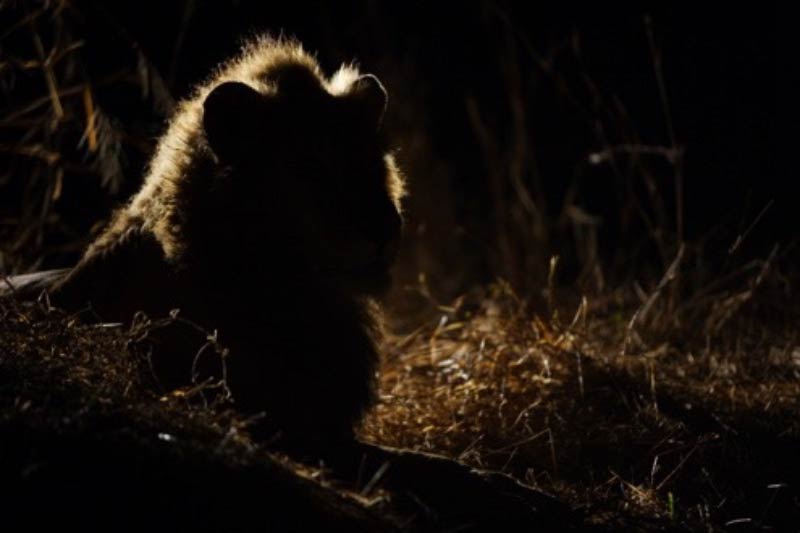
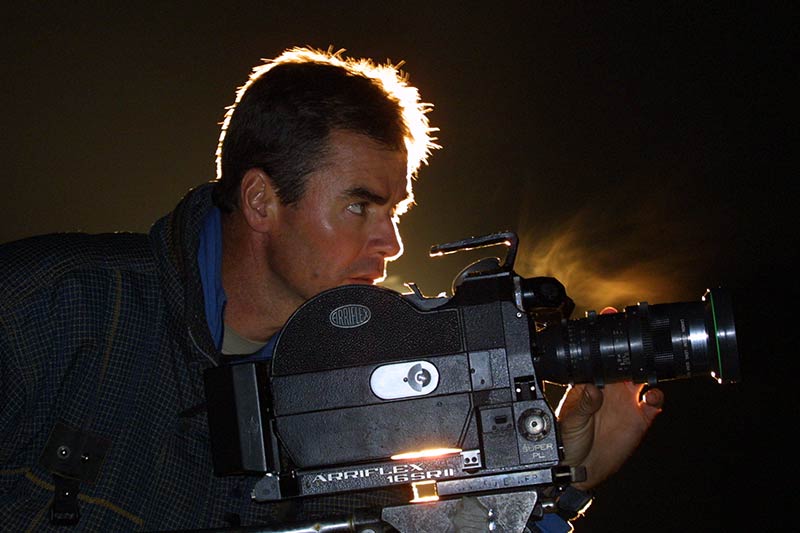
Richard had already developed his own look and feel in his films that nobody else was doing. That was filming at night with lights, with 2 vehicles, one with the camera and the other with a bank of lights mounted on a tripod. The lights running off 8 car batteries. With this lighting we were always trying to create that moonlit look.
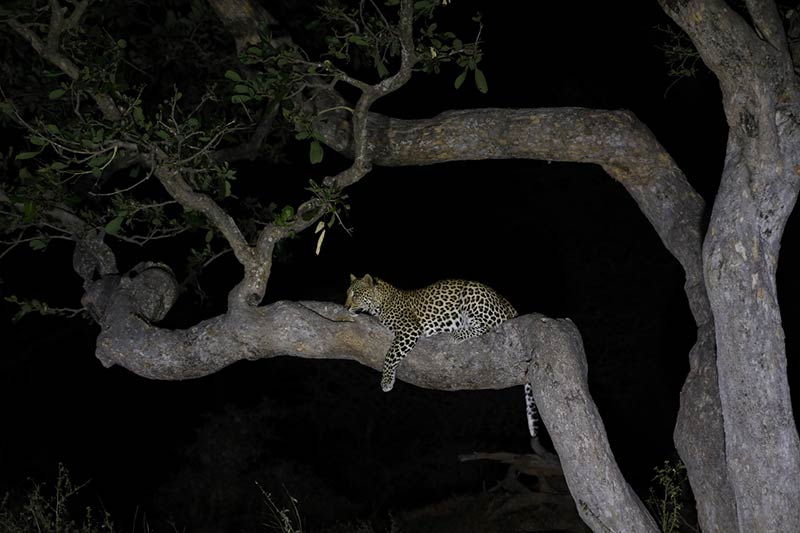
The first film we worked on, was a film on a female leopard, Richard had already started filming in the Tuli Block, Botswana. The same area I worked in with my first job. We went out that first night looking for the leopard. We drove around for some time looking for her and eventually found her. She was dead. Her body was lying there naked as poachers had skinned her and fled. It was the most awful sight. Close by was a big Knobthorn tree, which the poachers had put thorn brush all around and left a small opening where they’d set a snare. At the base of the tree, they tied the carcass of an impala to entice the leopard. Such a sad end to a most beautiful animal.

That put an end to the project, and we moved to the Okavango Delta to work on a film on spotted hyaenas, THE SISTERHOOD (BBC production). We built our own camp on the edge of the swamp and spent 18months filming, with Richard behind the camera and me doing the lighting.
Richard also got me to get my microlight (ultralight) license so we could fly and film over the Okavango. (No drones in those days.) I’ve never really been keen on flying, but flying a microlight really did give you that sense of freedom, of soaring like an eagle.
We were flying one day, Richard sitting behind me filming. We also had an old Bolex camera mounted on the wing filming us filming. The Bolex didn’t run on batteries. Instead, we’d have to wind it up and it would only shoot for about 30secs and then have to be wound again. So after every take we had to land, wind it up and take off again. We had landed several times on this small island with short grass, the perfect landing strip. I was then coming into land and I think a gust of wind picked us up and I landed about 2m short of the hard ground, in the mud. The wheels dug in and the microlight did a head-over-heels. It’s a miracle we weren’t injured. But now we had a dilemma. How were we going to get off the island across the deep water to the mainland? Water inhabited by crocodiles and hippos. Finding a log to carry us across seemed out the question as a log that size we wouldn’t be able to move. But luck had it, there was a dead Figtree near the water. Fig wood is very light and very bulky. It was perfect. We could both sit on it and holding our T-shirts to catch the wind, we slowly drifted to the mainland. From there we ran back to camp, about 5kms away, where are wives weren’t any the wiser of our dilemma.
All this time we’re shooting on 16mm film, which is hard to imagine in today’s world of video. Sometimes taking 3 months before you get to see the footage you’ve shot, as it must be sent away for developing. Not the instant gratification we get today.
As much as I was enjoying my new career, and having just finished this film on spotted hyaenas, I still didn’t realize what would be install for me years later with the Spotties.
Our next film was Brown Hyaenas in Namibia. Richard dropped me off with 10 rolls of film and said, “Go for it”. Up to this stage I’d hardly done any filming myself, only watching Richard in action. I ended up shooting most of this production.
Now I was operating the camera and had an assistant doing the lighting for me. We lived in the small fishing town of Luderitz where gale force winds blow all day and night. Really harsh conditions to film in.
Early one morning I had walked across the seal colony at Atlas Bay to film the stormy seas and huge waves rolling on to the beach in the stunning early morning light. Next to me was a huge rock and the waves were breaking the other side of it. Something made me look up and here was this monster wave peering over the rock. I grabbed the camera with my left hand and held onto the rock with my right and then it hit me like a steam train. The wave threw me into a gully, that was dry, but now full of water and rushing back out to sea. I managed to hold on and hobbled out the gully. I’d torn the ligaments in my ankle and broken my nose. Just then another wave arrived and I managed to get out the way. Thankfully no more waves came over the rock. I looked around for the camera, but couldn’t see it, except of the battery. I tried to pick it up with my right hand, but I couldn’t pick up the battery. I had dislocated my right shoulder. I picked it up with my left hand and hobbled across the seal colony with seals bleating their laughter at me.
Apart from rolling our car on the dirt road, (we were all fine) from Keetmanshoop to Luderitz, we finished the film STRANDWOLF – SURVIVOUR OF THE SKELETON COAST (BBC/National Geographic co-production), with no further mishap.


After spending some time with these hyaenas, I found they frequented town regularly, but whenever they did, they became incredibly nervous and would disappear if we approached. We wanted to document their lives in town as well as outside. They are walking through the streets, visiting the graveyard and similar shots. When working at Pretoria Zoo to film a Spotted Hyaena birth for our last film, there was a seemingly relaxed Brown hyaena in the adjacent pen. We befriended it and gave it scratches when it came up to the fence. Now working with Brown Hyaenas, we realized he would be our ideal candidate to follow through town. We got permission from the zoo to fly him to Luderitz and over the next couple of weeks we filmed his sojourns around town. When giving him cuddles you could feel his body and total lack of any muscle from being enclosed in a small pen all his life. The first week we had him out around town, he very quickly got exhausted, not being used to walking so much. Soon he started building muscle and when we took him into the sand dunes, he found his new found freedom and took off, absolutely loving it. Suddenly we were challenged and I had to ran him down, which wasn’t easy in those soft sands. When he returned to the zoo, now being a movie star, the zoo keeper called him Robert Redford.
One of the interesting scenes in that film, was a massive steel structure about 4 stories high in the middle of these massive sand dunes in the middle of this vast sand desert. (In the 18 months we were there, we never saw any rain.) Something only the Germans would have got right, back then at the turn of the last century. Brown hyaenas like to leave their paste marks wherever they can, but being mostly sand, there’s nowhere for them to paste. So this steel structure was an ideal place for them to mark and invariably they would come past here several times a week. The interesting thing was, about 100m from this structure was a mass human grave blown open by the wind. There were human skulls and bones scattered on the surface of the sand. Really eerie on a moonlit night. The mass grave was from people who had died in the Spanish flu epidemic in the 1920’s.
From Namibia we moved back to South Africa to Mala Mala Game Reserve. I was now fully entrenched as a cameraman working for Richard. Based at Mala Mala, I was now only 15mins away from where I grew up in the Kruger National Park, and from the stark sand dunes of the Namib, I was so happy to be back surrounded by huge trees, grassland and most of Africa’s iconic wildlife.
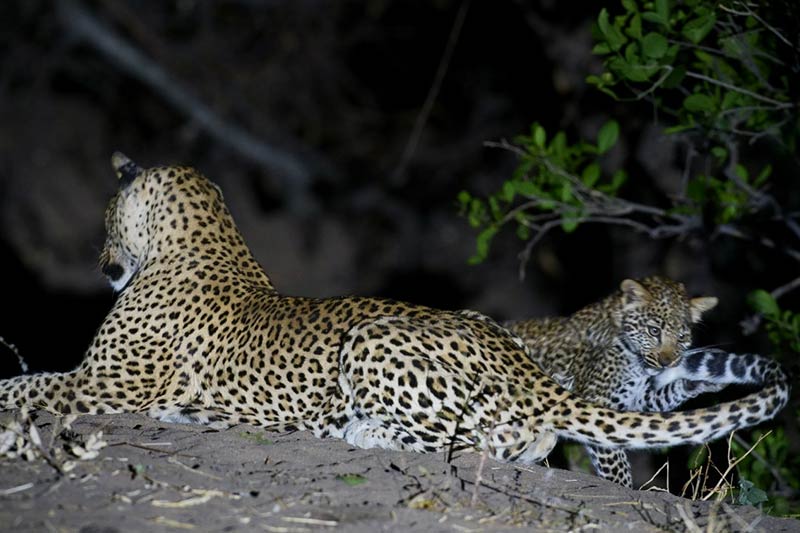
For the next 20months I filmed the interactions of leopard and warthog for Richard’s film BEAUTY AND THE BEASTS. A film I really enjoyed as it was full of unique behaviour and filming leopards is exciting on its own, anyway. Everything seemed to go to plan on this film without any dangerous encounters or situations.
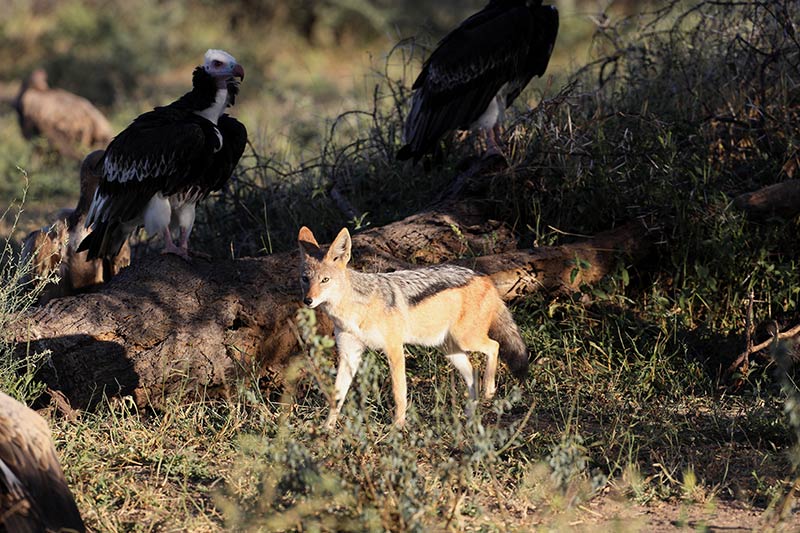
Having worked with Richard for 6yrs, I decided to go it alone. It wasn’t easy to get that first commission, but luckily, I had “Beauty and the Beasts” to show off my camera work to potential commissioners and was soon signed up by Survival Anglia to do a film on Jackals in Etosha National Park.
The authorities allowed us to camp out in the park, which was mostly open veld dotted with small bushes and the odd Acacia. So of course, we chose the shade of a couple of Acacia’s for our camp. But 6 months later when the rains arrived, we realized why the trees were there. That specific spot became a pan in the wet season. We had to move to the open.
Jackals proved to be quite a challenge as they’re so active ALL night. Not like leopards that enjoy their sleep.
My mother, twin brother, his wife and 2 kids came to visit us in Etosha. We’d heard the rains had fallen to the north and the river was flowing into the Etosha pan in the north. It was an area out of bounds do the public, but our filming permit allowed us access. We drove up there and found the river flowing and fanning out into the pan. Perfect spot for a picnic, which we thoroughly enjoyed.
Just when we were planning on heading back to camp, the car wouldn’t start. My brother is very mechanically minded, and I have a little knowledge too, but we just couldn’t get it to start. We didn’t have radio contact with anybody. No cell phones in those days. We had a serious dilemma.
It was decided I should walk back to camp to get another vehicle and Dale, my assistant, would walk with me. My mother, brother, his wife and kids and my wife and Lindy (only a year old but still breast feeding) would stay. We didn’t have much food, and they at least could get water from the river flowing into the pan.
Off we set, Dale and I. (Only when we got back did, we measure it, just over 60kms.) We decided that we would walk for 2hrs and rest for 10mins, and that we would never rest for more than 10mins. We left at 14h00 with 2litres of water between us. The first 2hrs, second and third were fine. Then our walks got shorter. Eventually we were walking about half an hour and resting for 10mins. Sunset came and we kept walking. The moon was thankfully up, so we could keep going. Early in the evening a hyaena came to investigate us, (not knowing much about hyaenas then, we were a bit nervous) but it soon left. Now incredibly thirsty we arrived at Okondeka waterhole after midnight. But in the moonlight, we could see this round shape at the water. A male lion? We weren’t going to chance it and climbed into a culvert under the road where we spent the rest of the night. At dawn I peeped out from our refuge, the shape was still there. A big tuft of grass. Thankfully it wasn’t a lion. We drank our fill and walked the last 10kms to camp where we took one of our filming vehicles and went to collect the rest of the family, who you can imagine were waiting rather anxiously wondering if we had made it back to camp.
Those stakes had nothing to do with the title of that film, BLACK JACK – HIGH STAKES (Survival Anglia TV)
Then it was back to Mala Mala for 8 years where we did several productions in that time. After the scrub veld of Etosha, I was just so happy to be back in the Lowveld with its big trees and perennial rivers. This was home.
Impalas are such beautiful animals and yet so over looked because they are so common. And being an antelope, it’s always hard to sell such a film as everyone is looking for action, drama, predation.
I was excited when Survival Anglia TV were happy to commission the film after the success of Blackjack.
That was the film, IMPALA BASIC INSTINCTS (Survival Anglia TV).
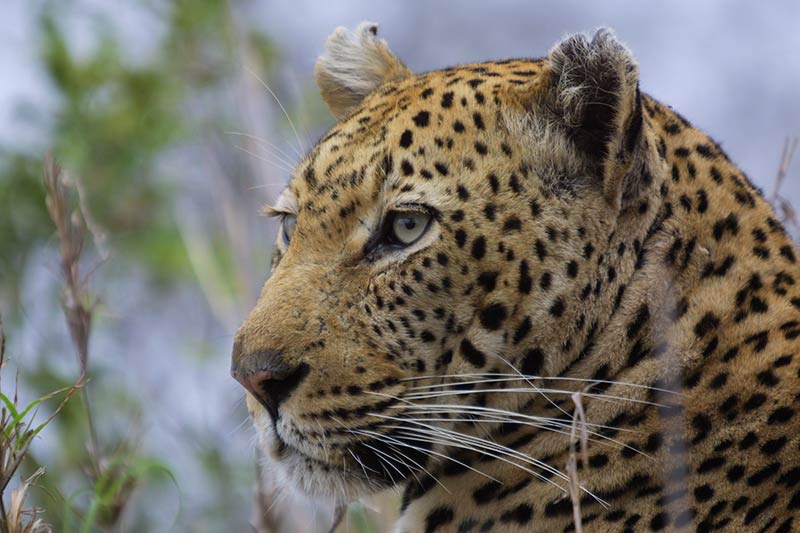
With more of a track record behind me, Geographic then came on board and commissioned STALKING LEOPARDS (National Geographic) – He was a young male when we started working with him, having just set up his territory in much the same area as we filmed Beauty and the Beasts. His territory included those female leopards.
This was the story about Tjololo (“the one who stands alond”). He was small for a male leopard but totally ruled the earth he walked.
I found him walking up a gully one day. I jumped out the car to film him low angle approaching. He kept coming. Unbeknown to me I was lying next to a tree stump. He walked up to the stump and turned to mark on it, peeing all over me.
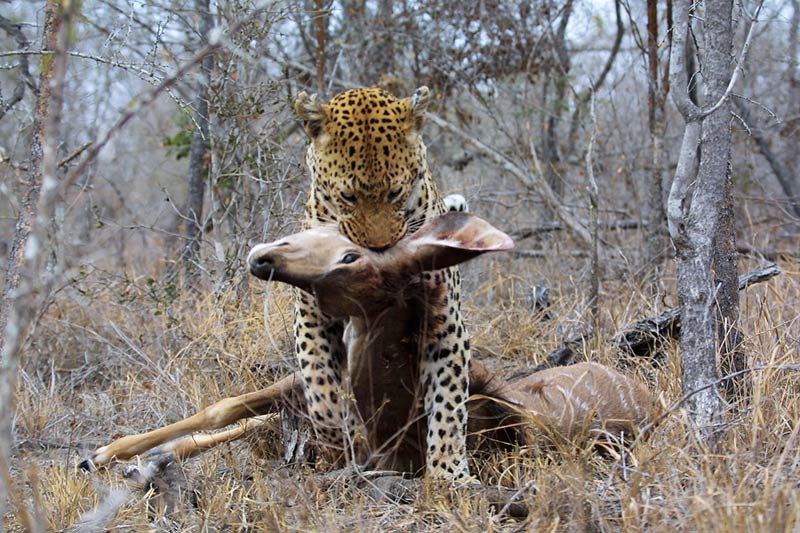
Another time, he’d killed a kudu cow. I was out the vehicle again filming him. He had the whole area to drag it wherever he wanted, which happened to be where I was sitting. I had to stand up to let him drag his trophy past me.
We were fortunate to spend many years with Tjololo, because after the film “Stalking Leopards”, National Geographic commissioned the 2-part Series, PREDATORS AT WAR (National Geographic) of which Tjololo again played his role.
There was so much predator activity on Mala Mala, that this film made a lot of sense.
Always trying to shoot from a low angle which makes the audience feel more engaged, there were of course times when instead of the predators being at war, I became the focus of their attention.
Although this film won a couple of Emmy Awards, there was some criticism about the series being too real and showing nature to be harsh. And yet all we were doing, is showing what nature is about. Not the fantasy world of a cheetah chasing a gazelle shot in ultra slow motion. See the amazing athleticism of the cheetah and the prey. And then the cheetah catches the gazelle and in slow motion we see them tumble to the ground in a cloud of dust and the cheetah grabs the gazelle by the throat. Shot in slow motion and with background music to fit the graceful nature of the chase, this all looks like a fairy tale and yet we have just witnessed a murder, which gives the audience a false sense of the reality of what happens in nature.


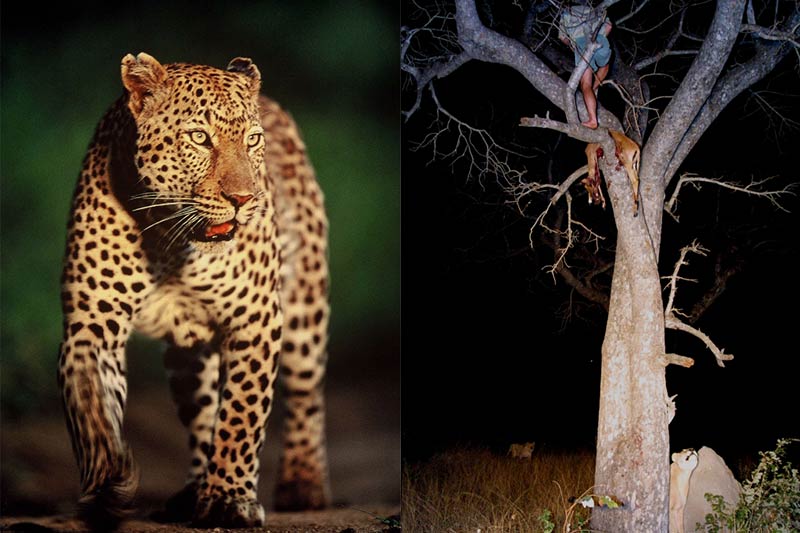
I remember the one scene where Tjololo had killed an impala and taken the kill up a tree, where he partially fed on it, then left. Always wanting to give the audience more, I wanted a shot from the leopard’s point of view looking down from the carcass to the ground below. It was night and with the filming lights on I climbed the tree with my camera. I was busy filming when unbeknown to me 2 lionesses approached from the darkness. They had smelt the kill, and I was up the tree ‘acting’ as if I owned the carcass. A rather serious predicament to be in. I had 2 options, either climb higher in the tree and hope they would only be interested in the carcass, or I could drop the carcass down to them. Thankfully, seeing me up the tree, the lionesses decided to leave.
The last film I did on Mala Mala, changed my whole vision of how I would produce films in the future.
HYENA QUEEN (National Geographic) – hyaenas had become a part of our every night life when following the other predators at Mala Mala and so it was this film came about. Little did I realize how this would change my whole approach to wildlife filmmaking.
The clan was denning under a huge granite rock, a site I’d been told about when I first arrived at Mala Mala 10 years before, but they had never used the site until now, which was perfect as it was the ideal spot to be able to film them dennng.
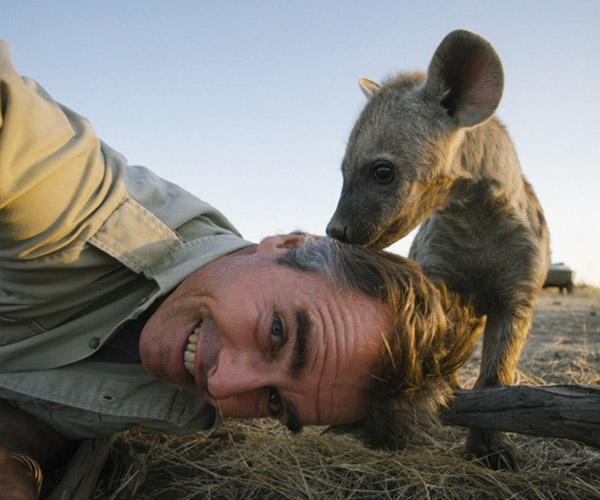
Early one morning at the den one of the youngsters, Scratchy, was milling around the rock. I was out the car on my tripod filming when Scratchy approached me. No hyaena had ever approached me in this way, feeling a little uneasy I was about to get back in the vehicle, but for some reason I didn’t. Instead, I held out my hand to Scratchy, not knowing whether she would sniff it, lick it or bite it. To my utter surprise, she didn’t do any of that, but pressed her chin into my hand, like a dog wanting attention. Not sure how to react, I wondered what she would do if I scratched her on her neck. So, I did just that, and in a state of utter ecstasy she stretched her neck up for me to scratch. She enjoyed this for a couple of minutes and then moved off. I couldn’t believe what had just happened. Had this wild animal actually sorted out my affection? Why? And it all seemed so natural.
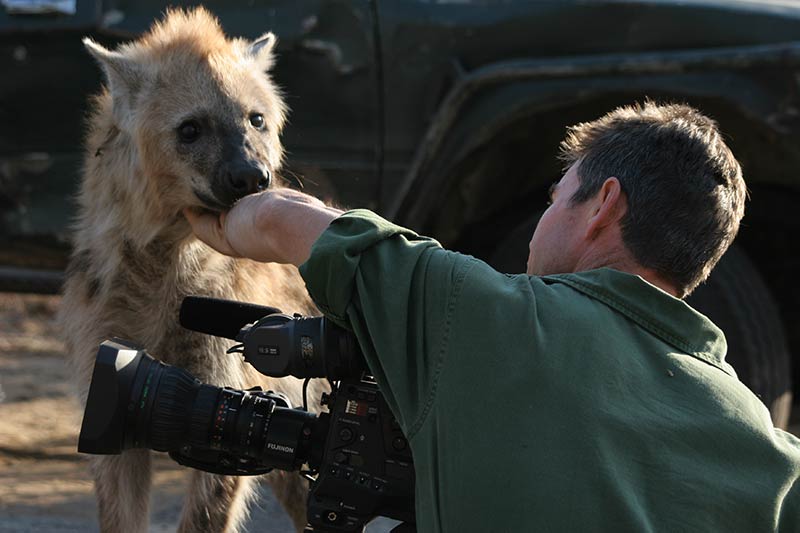

From that day on, whenever I was out the vehicle she would come for scratches, a behaviour totally brought on by her and not expecting anything but TLC. And that’s when I realized how many people feed wild animals to habituate them. And that’s all it is, habituation. But when you have a relationship with a wild animal where there is no food involved it goes to another level, Trust. And that’s it, trusting me and me trusting the animal. This was the big change in my filmmaking career, where I was not only documenting the animal’s lives, but it became my mission with each future project to develop an intimate relationship with my film subjects, always working with 3 very simple rules.
Rule 1. I NEVER feed the animals as this causes all sorts of complications and can often result in aggressive behaviour from the animal now always expecting food.
Rule 2. I never carry a weapon. When carrying a weapon, one has an arrogance about you and the animals pick that up and will never trust you.
Rule 3. They make the rules. That is, they decide if they want to interact with you. Just as it was Scratchy who approached me.
With these 3 very simple rules, it’s amazing how the natural world is very willing to accept us back.
Kim Wolhuter: Trusting the Wild
Discover the moment that changed everything, and how Kim built deep, trust-based relationships with wild animals.